


Giant White Blankets Spread Over Glaciers to Slow Down Melting


Those who venture out for a hike or a bike tour in the Alps during the summer months come across enormous white covers spread over the glaciers, resembling a giant bandage. Commonly known as 'glacier fleece' or technically as geotextile, these synthetic covers manage to reduce ice melting in the applied area by approximately 60%. However, experts issue a warning: While the method is extremely effective on a local scale, it does not possess the power to save the planet's glaciers.

Typically made from polypropylene and a few millimeters thick, these covers are laid out on glaciers from May until the beginning of September.
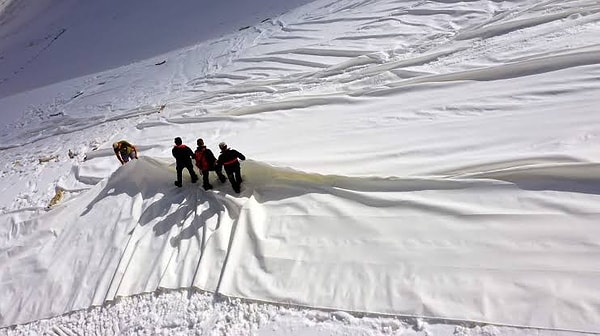
At altitudes above approximately 2200 meters, where solar radiation is the primary factor causing melting, white fabric protects the underlying ice by reflecting the radiation and insulating against air temperature.
For instance, thanks to this covering method applied for 10 years on the Diavolezza glacier in Engadin, the thickness of the ice at the protected spot was measured to be 10 meters more compared to the surrounding area. However, this success does not reflect the overall situation; in Switzerland, the covered area constitutes only 0.02% of all glaciers and is able to prevent only 0.03% of the annual ice loss.
The colossal economic barrier is the underlying reason why the method can't be applied to all glaciers.
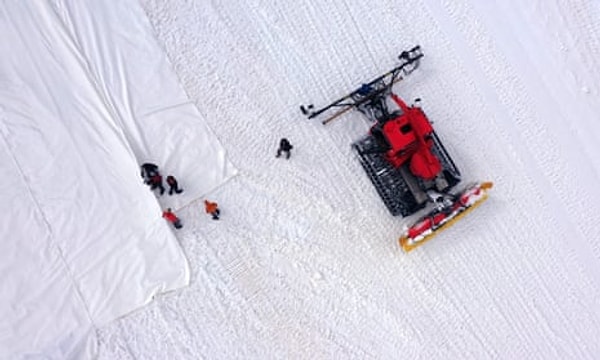
The cost per cubic meter of preserved ice ranges from 0.60 to 7.90 Swiss Francs. The annual bill for covering all the glaciers in Switzerland, however, exceeds 1 billion Swiss Francs, which is more than half of the annual revenue of all cable car businesses in the country.
Contrary to popular belief, these covers are not laid out to halt the climate crisis. Instead, they are used entirely for operational and commercial reasons such as stabilizing cable car poles, protecting the ice cave visited by tourists in the Rhone glacier, and ensuring access to ski slopes.
On the flip side of the coin, there lies an environmental disaster.
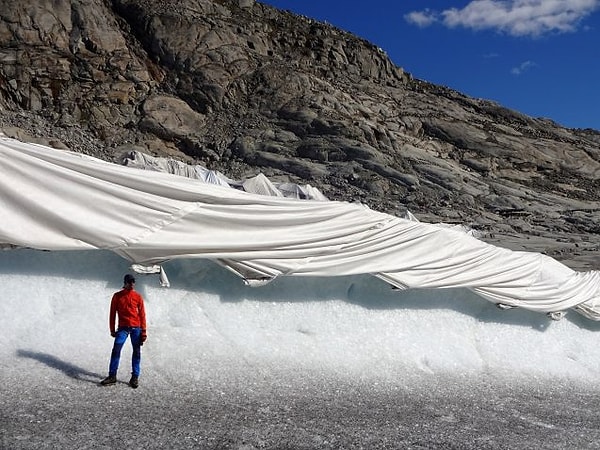
Polypropylene covers, exposed to the sun, wind, and rock falls, gradually wear out over time. Research conducted by the University of Innsbruck revealed that there are a total of 3 kilometers of plastic fibers (microplastics) in 1 square meter of ice under the cover. These fibers are transported to valleys and drinking water sources by melting waters.
In an effort to combat plastic pollution, researchers and businesses have turned to new alternatives. Testings began on PLA felts, which are produced from corn starch and biodegradable in nature, and cellulose covers derived from corn and tree fibers. PLA covers, produced over 20,000 square meters by 2025, were tested in areas such as Corvatsch and Laax, yielding positive results.
In summary, while 'glacier wool' may be a lifesaver for commercial businesses, it falls far short of offering a definitive solution against global warming.
Keşfet ile ziyaret ettiğin tüm kategorileri tek akışta gör!
 Test
Test
 Gündem
 Magazin
 Video
Video



Send Comment