


Future of Construction: Date Palm Fiber Strengthens Concrete for Safer Buildings


Across the Middle East and North Africa, the tons of agricultural waste left behind after the pruning, harvesting, and maintenance of millions of date palm trees have been transformed into a game-changing raw material for the construction industry. Scientists have discovered that these discarded or burned date palm fibers remarkably strengthen both concrete and mortar. This technology aims not only to curb environmental pollution, but also to construct much cheaper and more durable structures in arid regions.

The construction industry was on a quest for next-generation materials that, on one hand, inflict less harm on the environment, while on the other hand, fully adapt to hot climate conditions.
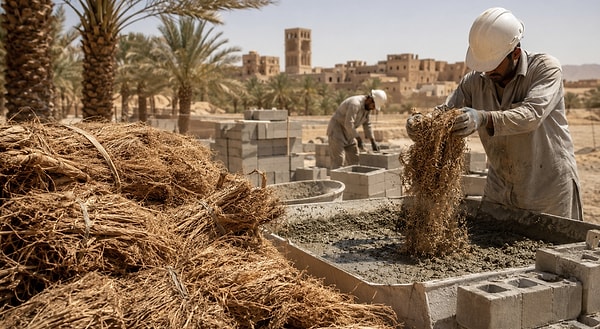
This latest development, which combines agriculture and engineering, has transformed date palm waste, once viewed as a rural burden, into a strategic construction input, particularly for desert and semi-arid countries.
Experimental studies published in prestigious scientific journals such as Fibers and Materials have proven that adding just 1% of date palm fibers to the cement mixture can dramatically alter the fate of the material. When compared to other synthetic steel and polypropylene fibers in tests, the addition of date palm fibers yielded these miraculous results:
Plant fibers are added to the mixture before the concrete is poured, controlling cracks during the material's drying process and evenly distributing the load and tension it carries.
The inclusion of date palm fibers boosts the indirect tensile strength of concrete by approximately 17%, while skyrocketing its bending and flexibility capacity by a staggering 60% to 85%.
The use of natural fibers completely eliminates the logistics and cost of transporting industrial reinforcement materials over long distances.
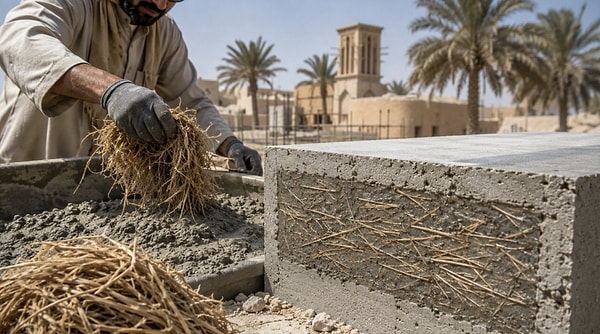
Indeed, date palm trees are among the most abundant resources in these regions. Experts emphasize that the use of these fibers helps to reduce the burning of agricultural waste, thereby mitigating the release of carbon into the atmosphere. Additionally, concrete made with date palm fibers forms a lighter structure compared to traditional concrete, offering a significant thermal insulation advantage against desert heat. This situation perfectly bridges the gap between a circular economy and local engineering.
Despite these fascinating results, researchers caution that care must be taken. In scenarios where the fibers are not used in the correct proportions and under the right technical controls, some weakening in the technical properties of the concrete can be observed.
Experts acknowledge that the technology shows great potential, but it has not yet fully matured to become a global and standard material in the construction industry. They suggest that more research needs to be conducted on the long-term durability and standardization of the material.
Nevertheless, the direction in the scientific world is clear: date palm waste, once viewed simply as trash to be burned, is gearing up to build the green and economical cities of the future.
Keşfet ile ziyaret ettiğin tüm kategorileri tek akışta gör!
 Test
Test
 Gündem
 Magazin
 Video
Video



Send Comment