


An Italian Traveler’s Account of Ramadan Bayram Customs in the 16th-Century Ottoman Empire


Between the years of 1532 and 1540, during the reign of Suleiman the Magnificent, the Italian traveler Luigi Bassano lived in the Ottoman Empire and documented the daily life of the period. The author-traveler devoted a section of his work, titled 'Daily Life in the Ottoman Empire during the Reign of Suleiman the Magnificent,' to the traditions of Ramadan Bayram (Eid al-Fitr). A page describing the 16th-century festival traditions was shared by a user named '@menesduran' on page X. The festival customs as narrated by the traveler, however, sparked a divide among the X users.

An Italian traveler, who lived during the reign of Suleiman the Magnificent, penned down the traditions of the Ramadan Festival in the 16th century.
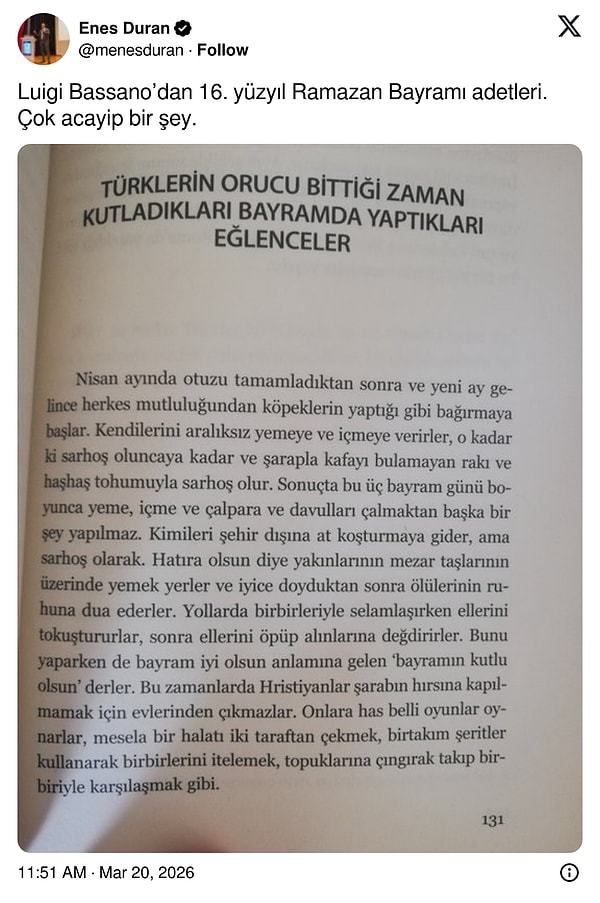
The chapter titled 'Festivities Performed by Turks at the End of Their Fasting Period' in the book includes the following statements:
'As April concludes and the new moon arrives, everyone begins to howl with joy, much like dogs. They indulge in continuous feasting and drinking, to the extent that they become intoxicated. Those who fail to achieve inebriation with wine resort to raki and poppy seeds. Consequently, these three days of celebration are filled with nothing but eating, drinking, and playing musical instruments such as the cymbals and drums. Some venture out of the city to race horses, albeit in a drunken state. In remembrance of their loved ones, they dine atop their relatives' tombstones and offer prayers for the departed souls once they are satiated. While greeting each other on the streets, they clasp hands, kiss their own hand, and touch their foreheads. During this exchange, they wish each other a happy holiday by saying 'may your holiday be blessed'. During these times, Christians stay indoors to avoid falling prey to the allure of wine. They engage in their own unique games, such as tug-of-war, pushing each other using various ribbons, and jingling bells attached to their heels during confrontations.'
The comments received on the shared post were as follows:
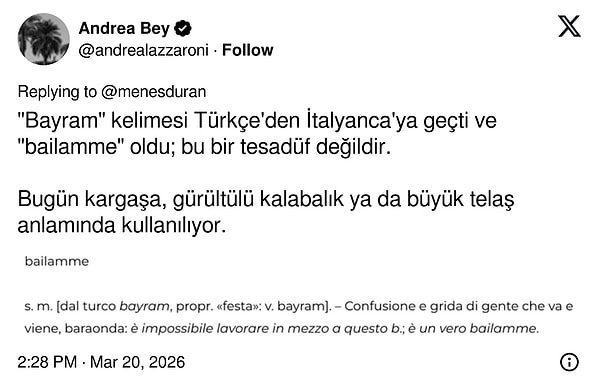
The term 'Bayram' transitioned from Turkish to Italian, morphing into 'bailamme'; this is no mere coincidence.
Today, it is utilized to denote chaos, noisy crowds, or significant hustle and bustle.
Keşfet ile ziyaret ettiğin tüm kategorileri tek akışta gör!
 Test
Test
 Gündem
 Magazin
 Video
Video



Send Comment