


An Earthquake-Resistant Cave House Came Out of a 3D Printer


Constructed in Japan, the O House serves as a striking example of the advancements 3D printing technology has made in residential projects. This two-story house, with its curvaceous design reminiscent of a cave, not only stands out due to its appearance, but also draws attention with its hybrid structure developed for earthquake safety.


The O House, constructed in Japan, stands out with its appearance that significantly deviates from traditional home designs.
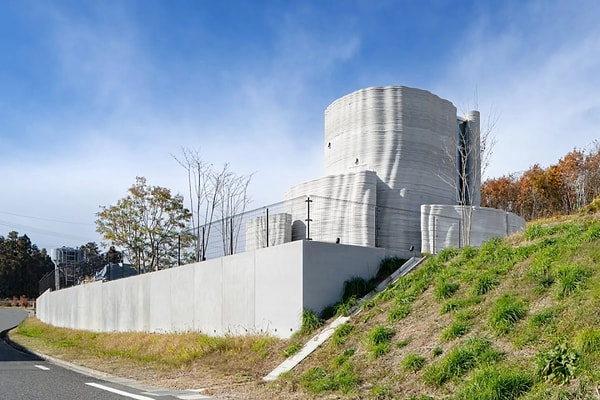
Drawing inspiration from the geometry of natural caves, the design offers a compact two-story living space.
Dubbed as Japan's first two-story 3D printed house, the O House spans an area of 50 square meters. Despite its relatively small size, the project is seen as a striking example of the future of housing, both in terms of its design and construction technique.
The cave formation was produced using a 3D printer.
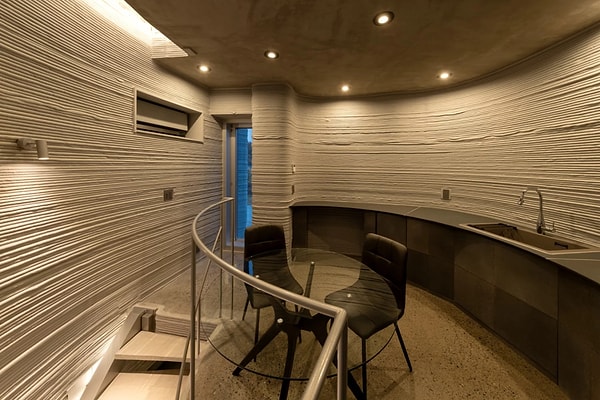
The project was brought to life by a large Japanese team, spearheaded by O House, Onocom, and Kizuki. The majority of the structure was built using a special 3D printer produced by COBOD. This printer constructed the house's arched walls, floor, and roof by layering a cement-like mixture.
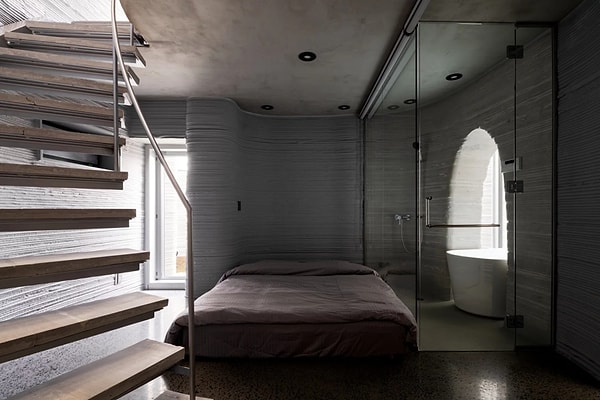
The interior of the house also adheres to the cave theme with its choice of curvaceous surfaces. Traditional window usage is kept to a minimum in the structure, with the need for light being primarily met through skylights.
The layout of the house deviates from conventional home plans. The kitchen, dining, and living areas are located on the upper floor, while the master bedroom and bathroom are situated on the lower level. To accommodate the curvy walls, the cabinets and furniture were also specially designed.
A hybrid system was employed to ensure resistance to earthquakes.
Due to Japan's high earthquake risk, the project did not solely rely on 3D printing technology. The structure was built using a hybrid method, combining 3D printing and traditional reinforced concrete systems.
The main load-bearing system of the house consists of a traditional reinforced concrete frame. The 3D printed walls are situated within this load-bearing system. Additionally, the structure is placed on a reinforced concrete strip foundation, supported by strengthening piles driven into the ground.
Even though the project is currently viewed as a demonstration house, the team behind it plans to construct more 3D printed houses in the future and intends to utilize this technology in areas such as post-disaster reconstruction.
Keşfet ile ziyaret ettiğin tüm kategorileri tek akışta gör!
 Test
Test
 Gündem
 Magazin
 Video
Video



Send Comment