


The Special Technique Developed by Nobel Prize-Winning Physicist Feynman That Leads to Success in Every Field


Would you like to easily master any subject of your choice? We're confident that the answer to this question would be a resounding 'yes' for most people. To achieve this, you can develop various techniques. For instance, while some people learn best visually, others prefer to learn by reading. But isn't there a 'proven' method to make learning easier?
This is where Richard Feynman, a Nobel laureate in Physics, comes into the picture. Feynman laid the foundations of accelerated learning and long-lasting knowledge acquisition with the technique he developed.
Let's delve into the Feynman technique and learn how to apply it.

Richard Feynman is a theoretical physicist, honored with a Nobel Prize.
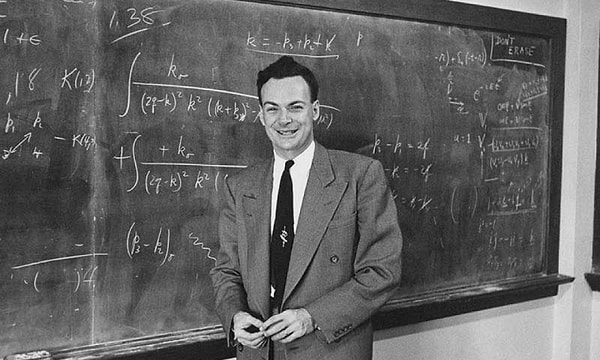
Born in a small town in the state of New York, USA, in 1918, Feynman had fully grasped the concept of derivatives and integrals by the tender age of 16. His triumphs did not stop there, they multiplied. At 17, Feynman embarked on his undergraduate studies at MIT. He completed his master's degree, earned his doctorate, and in 1942, with the US's entry into the war, he was summoned for the Manhattan Project, the atomic bomb project.
Following the end of the war, Feynman was recognized with the Nobel Prize, alongside Itiro Tomonaga and Julian Schwinger, for his significant contributions to Quantum Electrodynamics.
However, there is another reason why Richard Feynman is renowned worldwide today: the learning technique he developed. Feynman didn't just earn a Nobel Prize in Physics, he also mastered the art of simplifying complex topics. This gave birth to what we now know as the 'Feynman Technique' in our lives.
Let's start by understanding: What is the Feynman Technique?

The Feynman Technique, in its simplest terms, involves understanding a subject by associating it with different topics or practicing by explaining it to someone else. The goal of the Feynman Technique is to ensure that an individual can easily learn any subject from all angles and that this learning is permanent. When applied correctly, this technique is one of the most enduring learning styles.
Feynman's learning technique consists of four basic steps:
1. Choose a subject you want to learn.
2. Map out and simplify your chosen subject, and explain it as if you were explaining to a 12-year-old child.
3. Review the points you couldn't explain.
4. Test yourself again.
"If you can't explain a subject to a six-year-old, it means you haven't truly understood it yourself."

This quote, attributed to Einstein, perfectly encapsulates the essence of the Feynman Technique. It suggests that if you can explain a subject to a child, then you have truly grasped it. However, if you can't simplify it to that level, it's safe to say you haven't fully understood it. Let's delve into the steps of the Feynman Technique:
Choose and Map Out Your Subject
Grab a blank sheet of paper. Write down everything you know about the chosen subject; use a different colored pen for new information. This allows you to tangibly track your progress.
Explain the Subject as if to a Child
Once you're sure you've fully understood the subject, explain it using words a child would understand. If you can't explain it simply, it means you haven't fully grasped the subject.
While writing things down may seem straightforward, it's far from it. Writing can be beneficial in several ways. Firstly, it encourages better thinking. Secondly, it allows you to organize your thoughts. Lastly, a clear and comprehensible piece of writing reveals gaps in your understanding.
If you find yourself stuck at any point, circle back to the first step.

Reviewing and revising your work not only reveals areas you may not understand as well as you thought, but it also offers additional benefits. The process of revision enhances your understanding, allows you to gauge your progress, and fosters the development of new ideas.
When you identify weak spots, return to the source material. Examine these sections until you can explain them simply. If you can elucidate the topic to a child, then you've truly grasped the subject.
If you wish to test yourself again, try explaining it to someone else if possible. Afterwards, ask this person to summarize what you've explained.
Let's see, were you able to explain it well enough? :)
Who Can Utilize the Feynman Technique?
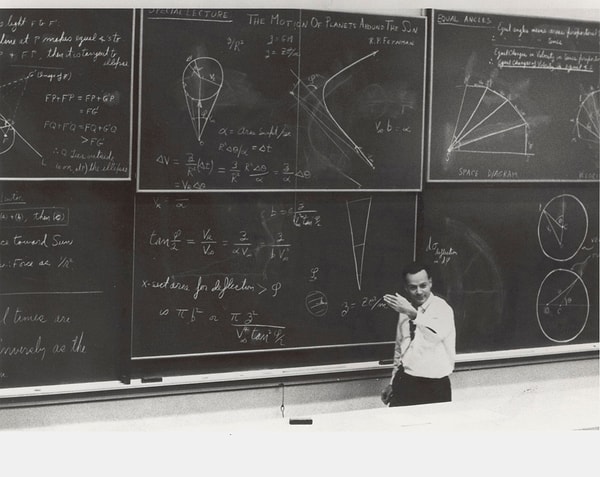
The Feynman technique is a tool that every student can easily utilize. Whether you're prepping for an exam or you're a university student, this method proves to be quite beneficial in making information stick. Moreover, you don't even have to be a student to reap its benefits. Learning is a lifelong process. If you're a working professional, you can prepare your presentations with this approach, or even apply it to your hobbies.
Naturally, students stand to gain the most from this technique, so let's delve a little deeper into the topic from a student's perspective.
The Feynman technique is particularly helpful in humanities subjects. It can assist in retaining information in subjects such as Turkish, History, Geography, and Literature. If you're struggling to write down lengthy topics, you can draw mind maps, color-code them, and vocally interpret these maps.
Employing various learning styles simultaneously activates different parts of our brain and facilitates connections between topics. Consequently, what we learn becomes ingrained in our memory for the long term.
Does the Feynman Technique truly work?

The answer to this question undoubtedly varies from person to person. However, it wouldn't be incorrect to say that it has worked for many people. For instance, it worked for me :)
Had I tried to learn the Feynman technique through the dull lines of a textbook, it likely wouldn't have piqued my interest, and I would have struggled to grasp it. Now, however, I've read about the Feynman technique from various sources, learned who Feynman was, used visuals, and most importantly, explained it to someone else. In doing so, I've practically applied the very topic I was explaining.
I'm certain that years from now, whenever the topic of the Feynman technique comes up, I'll be the one holding the floor. By using different materials and explaining the concept to someone else, I've managed to commit it to my long-term memory.
There's no harm in you giving it a try as well. It's been tested and approved!
Keşfet ile ziyaret ettiğin tüm kategorileri tek akışta gör!
 Test
Test
 Gündem
 Magazin
 Video
Video



Send Comment