


The Love Story Of The Bride Who Wore The Parachute That Saved Her Husband's Life As Her Wedding Dress


In August 1944, B-29 pilot Claude Hensinger was flying back from a bombing mission over Japan when one of his aircraft's engines caught fire. Claude Hensinger and his crew bailed out; he came down on jagged rocks and spent the night wrapped in his parachute. Three years later, in 1947, Claude Hensinger proposed to Ruth not with a ring but with that same parachute, and asked her to make her wedding dress out of it.
This is the story of a gown that began in World War II and ended up in the Smithsonian's collection.

Major Claude Hensinger was a B-29 pilot whose engine caught fire on the way back from a 1944 raid.
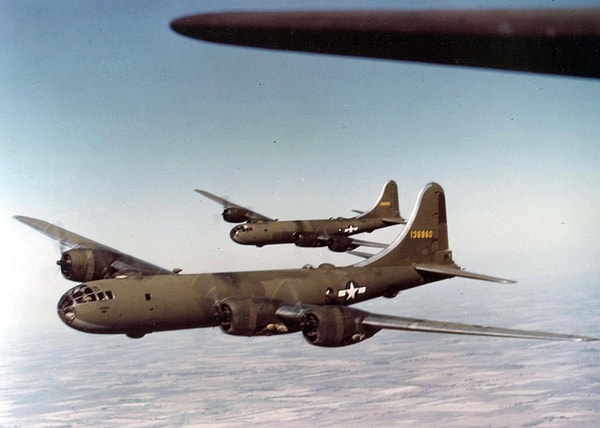
Major Claude Hensinger was a B-29 pilot with the 20th Air Force and one of the squadron leaders of the 444th Bombardment Group, stationed at a base in India. In August 1944 he and his crew took part in a bombing mission against the Japanese city of Yowata.
The target was hit, but on the way back to base one of the aircraft's engines burst into flames. Claude Hensinger and the crew tried to put the fire out and could not bring it under control.
The Jump
With the aircraft going down, the crew had one option left: their parachutes. They bailed out over a part of China that was not under Japanese occupation and landed in different spots across the area.
Claude Hensinger was the unlucky one. The ground he came down on was ringed with sharp rocks, with almost nowhere safe to land. He hit the rocks and got away with only minor injuries, but he was bleeding and there was nobody nearby to help.
A Night In The Open
Claude Hensinger had to spend the night outside in the cold. The only protection he had was the parachute that had just saved his life. He used the fabric as both blanket and pillow, kept warm and managed a few hours of sleep.
The next morning Chinese villagers found Claude Hensinger and the crew and took them in. The men were brought to safety, Claude Hensinger's injuries were treated, and a flight was arranged to take him back to the United States.
He wanted to bring one more thing home: the parachute. He kept it and later mailed it to his mother in Pennsylvania. She sent it to the dry cleaner to remove the bloodstains left from the landing. The blood never came out completely, and the mark can still be seen on the fabric today.
Three years later, Claude Hensinger proposed to Ruth with the parachute instead of a ring.

Claude Hensinger returned to Neffs, a small town in Pennsylvania. He and Ruth had known each other since childhood and attended the same church there. After the war the two began dating, and about a year later, in 1947, Claude Hensinger proposed.
He did it with the parachute in his hands. He held out the fabric that had saved his life and asked Ruth to have her wedding gown made from it.
How The Dress Was Made
Ruth was delighted by the proposal and puzzled by the parachute, but she did what he asked. She sketched the design after a dress she had seen in the window of the Hess Brothers store in Allentown, one that recalled Scarlett O'Hara's costumes in Gone with the Wind. Out of the parachute's 16 nylon panels came a multi-layered gown in the style of the pre-Civil War South.
Hilda Buck, the town's seamstress, sewed the bodice and the veil, and Ruth made the skirt herself. Short in front with a long train behind, the skirt takes its shape when the parachute cords are pulled.
The Wedding
The couple married on 19 July 1947 at the church in Neffs. Claude Hensinger did not see the dress until Ruth started down the aisle.
Three Brides, One Dress
The gown's story did not end there. About 25 years later the couple's daughter Susan wore it at her own wedding, and in 1989 so did Kim Shollenberger, the bride of their son David. Ruth said the dress had walked down the aisle of the same church three times.
In the early 1990s Ruth learned that the Smithsonian was looking for objects made from wartime parachutes and donated the gown and veil to the museum. The dress is in the Smithsonian's collection today. When Claude Hensinger died in 1996, the couple had been married for 49 years.
Sources: Smithsonian National Museum of American History, Ripley's, Collectors Weekly
Keşfet ile ziyaret ettiğin tüm kategorileri tek akışta gör!
 Test
 Gündem
 Magazin
 Video



Send Comment